
Are your GOS betraying you?
By Henrik Kolding Liboriussen, Product Coordinator, Hamlet Protein
In young animal nutrition, galacto-oligosaccharides can either support gut health or act as an anti-nutritional factor. The difference lies in the chemical structure, and it is essential knowledge when formulating diets for young animals.
Galacto-oligosaccharides (GOS) are often discussed as a group of carbohydrates with the same properties. This leads to confusion as GOS covers a broad range of compounds with different origins, structure and functional characteristics. In young animal nutrition, it is particularly important to distinguish between plant-derived alpha-galacto-oligosaccharides (α-GOS) and lactose-derived beta-galacto-oligosaccharides (β-GOS), as their physiological effects and modes of action differ significantly.
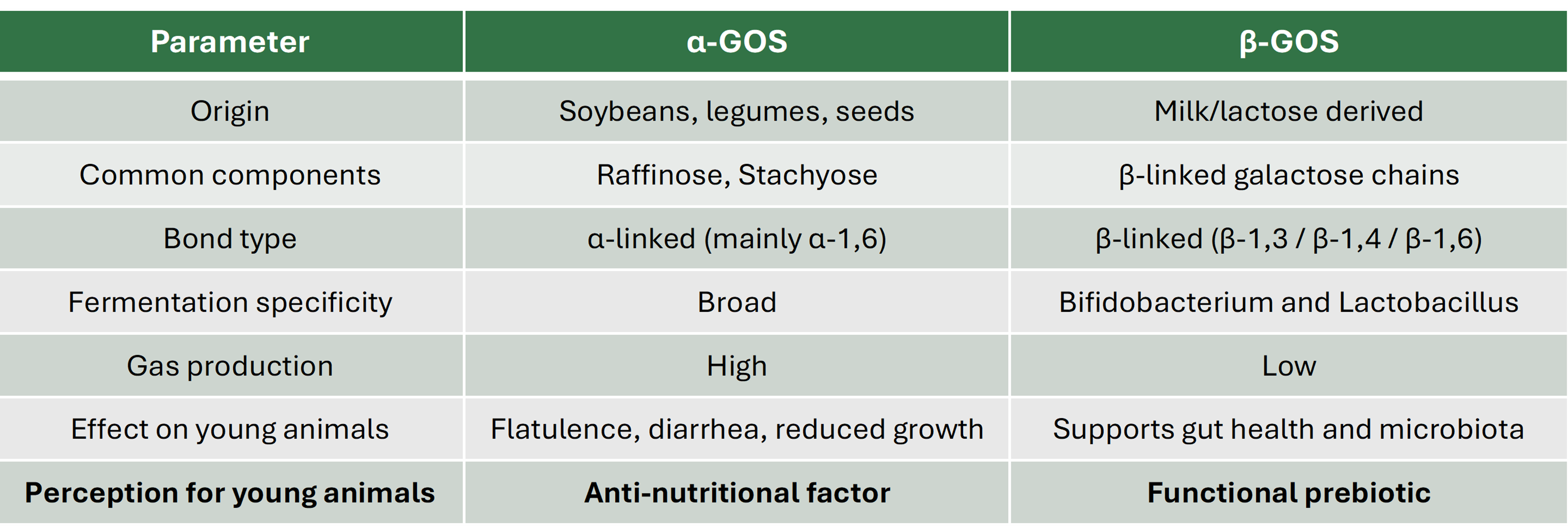
Table 1: Main differences between α-GOS and β-GOS with focus on perception in young animals.
What is the difference between α-GOS and β-GOS?
GOS are a group of carbohydrates that primarily consists of galactose units linked to a glucose unit. Based on the bonds between the galactose units and glucose unit, GOS can be categorized into two different groups: α-GOS and β-GOS.
In α-GOS, the units are linked by α-bonds, while in β-GOS they are linked by β-bonds1. This structural difference is crucial for how these compounds behave later in digestion. Both GOS groups cannot be digested by the animal itself, because animals lack the enzymes necessary for utilizing these compounds. However, GOS can be utilized by animal microbiomes because some microbes produce the necessary enzymes. This is where the structural difference in chemical bonds comes into play. Different enzymes are needed to utilize respectively α-GOS and β-GOS. The enzymes required for effectively utilizing β-GOS are not as widespread in microbiomes as the enzymes for utilizing α-GOS2. β-GOS are therefore more selectively utilized by beneficial bacteria and thereby act as a prebiotic.
What is a prebiotic?
A prebiotic is defined by ISAPP (The International Scientific Association for Probiotics and Prebiotics) as:
“A substrate that is selectively utilized by host microorganisms conferring a health benefit”3
If a substrate can be utilized by a broad range of microorganisms and causes undesirable gas production, it is not a prebiotic3
Raffinose and lactosucrose consist of the same three monosaccharides: galactose, glucose and fructose. In raffinose, galactose and glucose are connected by an α-bond, whereas lactosucrose contains a β-bond (Figure 1). This difference changes the two structures significantly and highlights why they behave differently in digestion.
α-GOS: An important ANF in soy and other legumes
Even though there are 20 times more α-GOS (60 mg/g) than trypsin inhibitors (3 mg/g) on average in soybean meal (SBM), it is not always considered in diet formulation. The α-GOS present in soy, that should be considered, are primarily stachyose and raffinose. Raffinose is the shortest α-GOS and consists of one galactose unit, one glucose unit and one fructose unit (Figure 1). Other α-GOS are typically synthesized from raffinose and therefore, α-GOS are sometimes referred to as raffinose family oligosaccharides (RFOs)1.
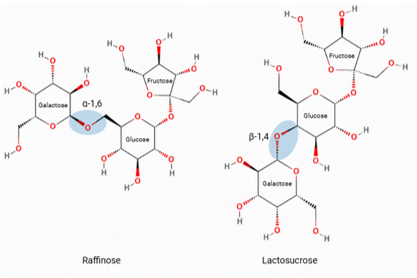
Figure 1: Raffinose and lactosucrose. The difference in structural configuration between these compounds is due to the different bindings between the galactose and glucose unit as highlighted in the blue circles. The 2D structures are adapted from PubChem23
The negative effects of α-GOS on the health and performance of young animals are well documented in the literature. High dietary levels of α-GOS can result in osmotic diarrhea and higher FCR4, shorter retention time and lower nitrogen retention5, reduced digestibility6,7, decreased metabolizable energy8 and reduced activity of digestive enzymes9. Together these effects result in lower performance, which is why α-GOS are considered one of the main anti-nutritional factors in soybeans and SBM10, 11, 12.
α-GOS are also known for causing flatulence due to increased gas production5, 10, 13. This gas production is not caused by beneficial bacteria, but by other bacteria, which might be pathogenic. A study investigated α-GOS utilization by bacterial strains in the gut and found that 196 of 528 examined bacterial strains in the gut had genes related to raffinose utilization14. This highlights how widespread the ability to utilize α-GOS is and, it has been found that the pathogenic bacteria Salmonella enterica, Klebsiella pneumoniae and Escherichia coli all contained genes for the utilization of α-GOS15. Therefore, the high levels of raffinose and stachyose found in SBM should not be considered prebiotic for young or vulnerable animals.
What do β-GOS and milk oligosaccharides have in common?
β-GOS are naturally found in animal milk16, but they represent only a minor portion of the oligosaccharide profile, which is dominated by milk oligosaccharides (MO). MO are important for shaping the early life microbiota, since they stimulate growth of beneficial bacteria and prevent pathogen attachment to the intestinal epithelium by acting as decoys17.
MO are structurally more complex than β-GOS, due to their more branched structure and incorporation of the monosaccharides fucose, N-acetylglucosamine and sialic acid18. Due to this complexity, it requires many enzymes to efficiently use these compounds. Through host-microbe coevolution, bifidobacteria have evolved the enzymatic ability to utilize MO very efficiently19. A key feature in this symbiotic relationship is the unique pathway, the “bifid shunt”, which enables bifidobacteria to yield more energy than related pathways20.
Because β-GOS resembles the core structure of MO, bacteria that evolved to utilize MO are also capable of utilizing the β-GOS16. For this reason, β-GOS are commonly added to infant formula, since the simpler structure can be synthesized quite effectively in production, while still maintaining some of the same prebiotic effects as MO16.
What feed formulators should consider
Young animals have a microbiome which is not fully established21. It means that they are sensitive to compounds, like α-GOS, that can be utilized by both beneficial and pathogenic bacteria – especially during challenging periods such as weaning.
It is therefore important to avoid a high level of α-GOS in diets during critical periods. α-GOS should be considered by us formulators in the formulation matrix for young or challenged animals alongside other ANFs, such as trypsin inhibitors.
When the animal gets a stable microbiome and is not in a critical period, α-GOS can be included at a higher dose in the diet. In this situation, the beneficial bacteria will already dominate the microbiome and utilize the α-GOS. Opportunistic pathogens will not be able to outcompete the established microbiome if the animal is healthy.
One way to utilize the great potential of soy in diets for young animals is to choose a soy product with a safe level of α-GOS. An option is to shift to natural low oligosaccharides SBM22, but it will not solve the challenges with the other ANFs naturally present in soy. An alternative approach is to use a processed soy product. Through the patented bioconversion process of Hamlet Protein, α-GOS content is reduced to levels suitable for young animals. The product, HP 300, contains six times less α-GOS than SBM and provides proteins that are fit for early life nutrition. The process of Hamlet Protein not only targets α-GOS - it also reduces the level of trypsin inhibitors and β-conglycinin. This results in products with a guaranteed low level of ANFs, improved protein accessibility and consistent nutritional values.
Find the right protein strategy for your operation
Talk with a Hamlet Protein expert to discover how HP 300 can help support animal performance, gut health, and feed efficiency.
References
- Ignatova, I., Arsov, A., Petrova, P., & Petrov, K. (2025). Prebiotic effects of α-and β-galactooligosaccharides: The structure-function relation. Molecules, 30(4), 803.
- Lockyer, S., & Stanner, S. (2019). Prebiotics–an added benefit of some fibre types. Nutrition Bulletin, 44(1), 74-91.
- Gibson, G. R., Hutkins, R., Sanders, M. E., Prescott, S. L., Reimer, R. A., Salminen, S. J., ... & Reid, G. (2017). Expert consensus document: The International Scientific Association for Probiotics and Prebiotics (ISAPP) consensus statement on the definition and scope of prebiotics. Nature reviews Gastroenterology & hepatology, 14(8), 491-502.
- Teague, K. D., Tellez-Isaias, G., Chai, J., Petrone-Garcia, V., Vuong, C. N., Blanch, A., ... & Rochell, S. J. (2023). Dietary soy galactooligosaccharides affect the performance, intestinal function, and gut microbiota composition of growing chicks. Poultry Science, 102(4), 102440
- Zhang, L., Li, D., Qiao, S., Wang, J., Bai, L., Wang, Z., & Han, I. K. (2001). The effect of soybean galactooligosaccharides on nutrient and energy digestibility and digesta transit time in weanling piglets. Asian-Australasian Journal of Animal Sciences, 14(11), 1598-1604.
- Smiricky, M. R., Grieshop, C. M., Albin, D. M., Wubben, J. E., Gabert, V. M., & Fahey Jr, G. C. (2002). The influence of soy oligosaccharides on apparent and true ileal amino acid digestibilities and fecal consistency in growing pigs. Journal of Animal science, 80(9), 2433-2441.
- Li, Z., Wang, Q., Xie, F., Liu, D., Li, Y., Lyu, Z., & Lai, C. (2017). Oligosaccharides are a key factor in prediction of amino acid digestibility in soybean meal of different origins when fed to growing pigs. Asian-Australasian Journal of Animal Sciences, 30(12), 1724.
- Leske, K. L., Jevne, C. J., & Coon, C. N. (1993). Effect of oligosaccharide additions on nitrogen-corrected true metabolizable energy of soy protein concentrate. Poultry Science, 72(4), 664-668.
- Zeng, Z., Zhang, Y., He, J., Yu, J., Mao, X., Zheng, P., ... & Chen, D. (2021). Effects of soybean raffinose on growth performance, digestibility, humoral immunity and intestinal morphology of growing pigs. Animal Nutrition, 7(2), 393-399.
- Choct, M., Dersjant-Li, Y., McLeish, J., & Peisker, M. (2010). Soy oligosaccharides and soluble non-starch polysaccharides: a review of digestion, nutritive and anti-nutritive effects in pigs and poultry. Asian-Australasian journal of animal sciences, 23(10), 1386-1398.
- Liying, Z., Li, D., Qiao, S., Johnson, E. W., Li, B., Thacker, P. A., & Han, I. K. (2003). Effects of stachyose on performance, diarrhoea incidence and intestinal bacteria in weanling pigs. Archives of Animal Nutrition, 57(1), 1-10.
- Stein, H. H., Roth, J. A., Sotak, K. M., & Rojas, O. J. (2013). Nutritional value of soy products fed to pigs. Swine Focus, 4, 1-17.
- Navarro, D. M., Abelilla, J. J., & Stein, H. H. (2019). Structures and characteristics of carbohydrates in diets fed to pigs: a review. Journal of Animal Science and Biotechnology, 10(1), 39.
- Mao, B., Tang, H., Gu, J., Li, D., Cui, S., Zhao, J., ... & Chen, W. (2018). In vitro fermentation of raffinose by the human gut bacteria. Food & function, 9(11), 5824-5831.
- Pham, H. H. T., Kim, D. H., & Nguyen, T. L. (2023). Wide-genome selection of lactic acid bacteria harboring genes that promote the elimination of antinutritional factors. Frontiers in Plant Science, 14, 1145041.
- Tao, B., Chen, Y., He, R., Huang, T., Liang, S., Chen, H., ... & Jiang, J. (2026). Galactooligosaccharides Based on β-Galactosidase-Catalyzed Synthesis: Function, Biosynthesis and Optimization Strategy. Foods, 15(10), 1803.
- Moore, R. E., Xu, L. L., & Townsend, S. D. (2021). Prospecting human milk oligosaccharides as a defense against viral infections. ACS infectious diseases, 7(2), 254-263.
- Jang, K. B., & Kim, S. W. (2022). Role of milk carbohydrates in intestinal health of nursery pigs: a review. Journal of Animal Science and Biotechnology, 13(1), 6.
- Kumar, H., Collado, M. C., Wopereis, H., Salminen, S., Knol, J., & Roeselers, G. (2020). The bifidogenic effect revisited—ecology and health perspectives of bifidobacterial colonization in early life. Microorganisms, 8(12), 1855.
- Pokusaeva, K., Fitzgerald, G. F., & Van Sinderen, D. (2011). Carbohydrate metabolism in Bifidobacteria. Genes & nutrition, 6(3), 285-306.
- Choi, H., Deng, Z., & Kim, S. W. (2025). Impacts of different dietary soybean meal levels on jejunal immunity of nursery pigs at different days post-weaning. Journal of Animal Science and Biotechnology, 16(1), 138.
- Rosso, A., Castanedo, M., Meloni, R., Pelosin, P., Corredig, M., Martínez-Abad, A., & Blandino, M. (2026). Agronomic traits and nutritional features of importance in low-raffinose genotypes for added-value soybeans. Journal of Agriculture and Food Research, 102654.
- https://pubchem.ncbi.nlm.nih.gov/compound/Raffinose#section=2D-Structurehttps://pubchem.ncbi.nlm.nih.gov/compound/174626#section=2D-Structure

Frequently asked questions
What is the difference between αlpha-GOS and βeta-GOS?
In α-GOS, the galactose and glucose units are linked by α-bonds, while in β-GOS they are linked by β-bonds. This difference means that β-GOS primarily are being utilized by beneficial bacteria as a prebiotic, while α-GOS can be utilized by pathogenic bacteria.
Why are αlpha-GOS not prebiotic?
Since α-GOS can be utilized by pathogenic bacteria in young animals, they do not fulfill the requirement for prebiotics. Prebiotics should be selectively utilized by beneficial bacteria and not by pathogenic bacteria.
How do αlpha-GOS affect young animals?
When pathogenic bacteria utilize α-GOS, it causes increased gas production and thereby flatulence. High dietary levels of α-GOS can result in osmotic diarrhea, reduced digestibility and lower performance. This is why α-GOS are considered one of the main anti-nutritional factors in soybeans and soybean meals.
What is a safe level of αlpha-GOS for young animals?
Defining precise thresholds is always challenging because they depend on multiple factors, including the number and type of stressors, animal species, health status, overall wellbeing, and environmental conditions. We recommend not exceeding the level of 1% α-GOS on a complete feed basis.
How can αlpha-GOS in soybean meal be reduced?
The amount of α-GOS in soybean meals can be reduced through a proper processing method. Through the patented bioconversion process of Hamlet Protein, α-GOS content is reduced to levels suitable for young animals.
About HAMLET PROTEIN
